
Many small business owners assume cybercriminals only target large corporations.
Unfortunately, attackers often prefer smaller organizations because they tend to have fewer security resources, smaller IT teams, and less formal security processes.
The good news is that most successful cyberattacks exploit the same mistakes over and over again.
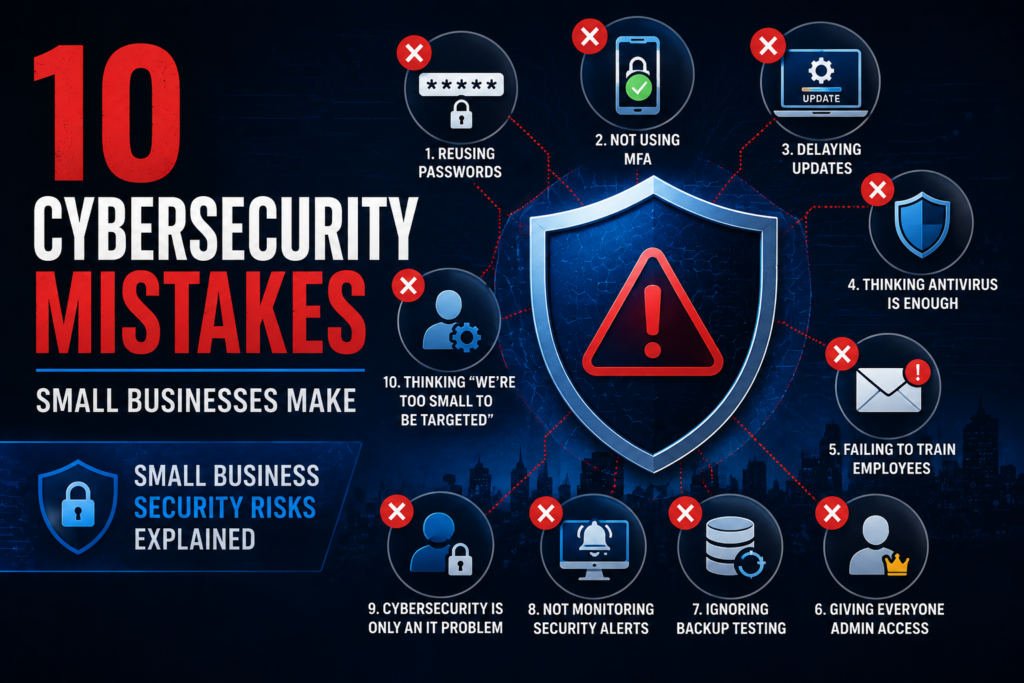
Here are ten of the most common cybersecurity mistakes small businesses make—and how to avoid them.
1. Reusing Passwords Across Multiple Systems
Password reuse remains one of the most common security issues.
If an employee uses the same password for email, cloud services, and personal websites, a breach at one service can potentially expose multiple accounts.
What To Do Instead
Use unique passwords for every account and consider using a reputable password manager.
2. Not Enabling Multi-Factor Authentication (MFA)
Stolen passwords are responsible for a significant percentage of account compromises.
Without MFA, a stolen password may be all an attacker needs.
What To Do Instead
Enable MFA on:
- Microsoft 365
- Google Workspace
- Banking platforms
- Remote access systems
- Password managers
3. Delaying Software Updates
Many businesses postpone updates because they seem inconvenient.
Unfortunately, attackers actively search for systems running known vulnerable software.
What To Do Instead
Apply security updates promptly and establish a regular patch management process.
4. Believing Antivirus Is Enough
Traditional antivirus software remains important, but modern attacks often involve phishing, credential theft, social engineering, and cloud-based compromises that antivirus alone cannot stop.
What To Do Instead
Think of cybersecurity as layers of protection rather than a single product.
5. Failing To Train Employees
Employees are often the first line of defense.
Without training, they may unknowingly click malicious links, download malware, or disclose sensitive information.
What To Do Instead
Provide regular cybersecurity awareness training and encourage employees to report suspicious activity.
6. Giving Everyone Administrative Access
Many organizations grant employees more privileges than they actually need.
The more access an account has, the more damage an attacker can potentially cause if that account is compromised.
What To Do Instead
Follow the principle of least privilege and grant only the access necessary for each role.
7. Ignoring Backup Testing
Many businesses assume their backups work because backup software reports success.
Unfortunately, successful backups do not always guarantee successful recovery.
What To Do Instead
Periodically test your ability to restore files, systems, and critical business data.
8. Not Monitoring Security Alerts
Modern systems generate a tremendous number of alerts.
Many organizations simply ignore them because there are too many to review manually.
Unfortunately, important warnings often get buried in the noise.
What To Do Instead
Establish a process for reviewing security alerts and prioritizing issues that require action.
9. Assuming Cybersecurity Is Only an IT Problem
Cybersecurity affects every department.
Finance, human resources, operations, sales, and executive leadership all play a role in protecting the organization.
What To Do Instead
Treat cybersecurity as a business issue rather than a purely technical issue.
10. Thinking “We’re Too Small To Be Targeted”
This may be the most dangerous misconception of all.
Attackers often automate their efforts and scan the internet for vulnerable systems without caring who owns them.
Small businesses are not targeted because they are famous.
They are targeted because they are vulnerable.
What To Do Instead
Focus on reducing risk rather than assuming attackers will overlook your organization.
The Good News
The majority of successful cyberattacks do not involve advanced hacking techniques.
Instead, they take advantage of common weaknesses that can often be corrected with reasonable effort and planning.
Small improvements made consistently over time can dramatically strengthen an organization’s security posture.
Final Thoughts
Perfect cybersecurity does not exist.
Every organization faces risk.
However, avoiding these common mistakes can significantly reduce the likelihood of becoming the next victim of a cyberattack.
The goal is not to eliminate every threat.
The goal is to make your business a more difficult target so cybercriminals will look elsewhere.