
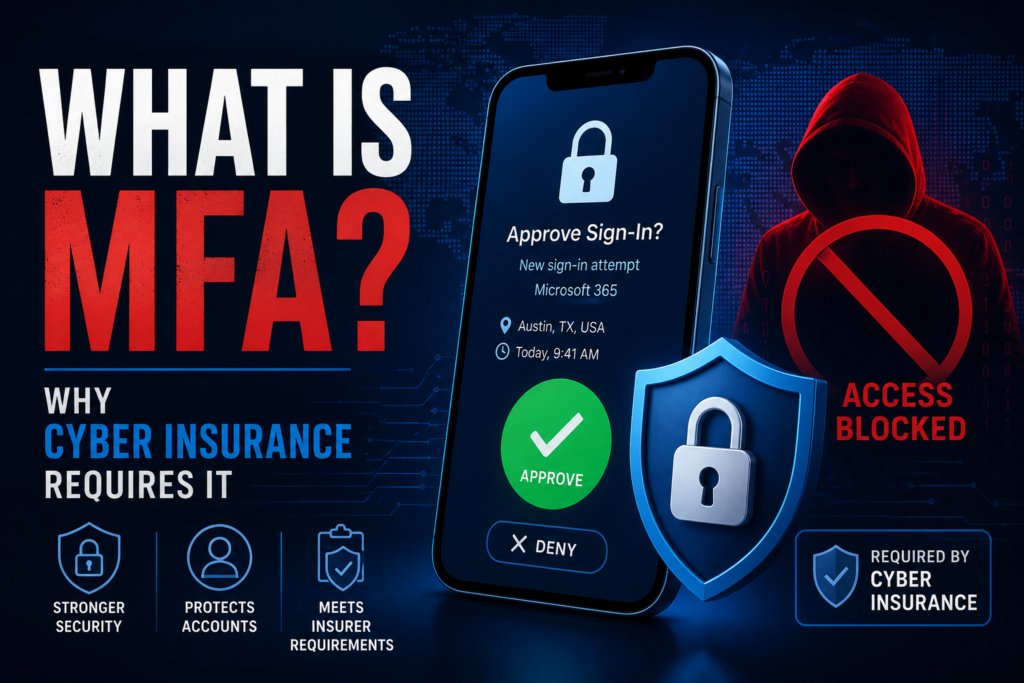
If you’ve applied for cyber insurance recently, you’ve probably encountered a question about Multi-Factor Authentication, often called MFA.
For many business owners, the requirement can feel confusing or frustrating.
After all, if your employees already use passwords, why is an additional security measure necessary?
The answer is simple:
Passwords alone are no longer enough.
What Is Multi-Factor Authentication?
Multi-Factor Authentication (MFA) is a security feature that requires users to provide more than one form of verification when signing in.
Typically, this means combining:
Something You Know
Your password.
Something You Have
A smartphone, security key, or authentication app.
Something You Are
A fingerprint, facial scan, or other biometric identifier.
Most businesses use the first two factors.
For example:
You enter your password and then approve a sign-in request using an app on your phone.
Even if someone steals your password, they still cannot access your account without the second factor.
Why Passwords Alone No Longer Work
Many people assume a strong password provides adequate protection.
Unfortunately, cybercriminals have numerous ways to obtain passwords:
- Phishing emails
- Fake login pages
- Data breaches
- Malware
- Password reuse
- Social engineering
In many cases, victims have no idea their password has been compromised.
Once an attacker obtains valid credentials, they can often access email, cloud applications, business systems, and sensitive data.
MFA creates an additional barrier that significantly reduces this risk.
A Real-World Example
Imagine an employee receives an email that appears to come from Microsoft.
The message warns that their mailbox is full and instructs them to sign in immediately.
The employee clicks the link and unknowingly enters their credentials into a fake website.
Without MFA:
The attacker can immediately log in using the stolen username and password.
With MFA:
The attacker is stopped because they cannot approve the login request on the employee’s phone.
A single security control prevents the compromise.
Why Insurance Companies Care About MFA
Cyber insurance providers pay millions of dollars each year in claims related to ransomware, business email compromise, and data breaches.
Over time, insurers discovered a common pattern:
Many successful attacks began with stolen passwords.
As a result, insurance companies increasingly require MFA because it dramatically reduces the likelihood of account compromise.
From the insurer’s perspective, MFA lowers risk.
Lower risk means fewer claims.
Fewer claims help keep insurance costs manageable for everyone.
Where Should MFA Be Enabled?
Ideally, MFA should be enabled anywhere sensitive information or critical business functions exist.
Priority systems include:
Microsoft 365
Email accounts are among the most frequently targeted systems.
Google Workspace
Cloud-based email and productivity platforms should always be protected.
Remote Access Systems
VPNs, remote desktop gateways, and remote management tools should require MFA.
Financial Platforms
Banking and payment systems are high-value targets for attackers.
Password Managers
A compromised password manager can expose numerous accounts.
Administrative Accounts
Administrator accounts should always have additional protection.
Is MFA Inconvenient?
Some users initially find MFA annoying.
However, modern solutions are far less disruptive than they once were.
Many authentication apps allow users to approve login requests with a single tap.
The few seconds spent verifying a login are insignificant compared to the cost of recovering from a cyberattack.
Does MFA Make Me Completely Secure?
No.
No security control can eliminate risk entirely.
Attackers continually develop new techniques, and businesses should implement multiple layers of protection.
However, MFA remains one of the most effective and affordable cybersecurity measures available.
Security experts consistently rank it among the highest-value controls organizations can implement.
Final Thoughts
Cyber insurance companies require Multi-Factor Authentication for a simple reason:
It works.
Most modern cyberattacks begin with stolen credentials.
MFA makes those stolen credentials significantly less valuable to attackers.
If your organization has not yet enabled MFA, now is the time.
The small inconvenience of approving a login request is far preferable to the financial and operational impact of a successful cyberattack.