
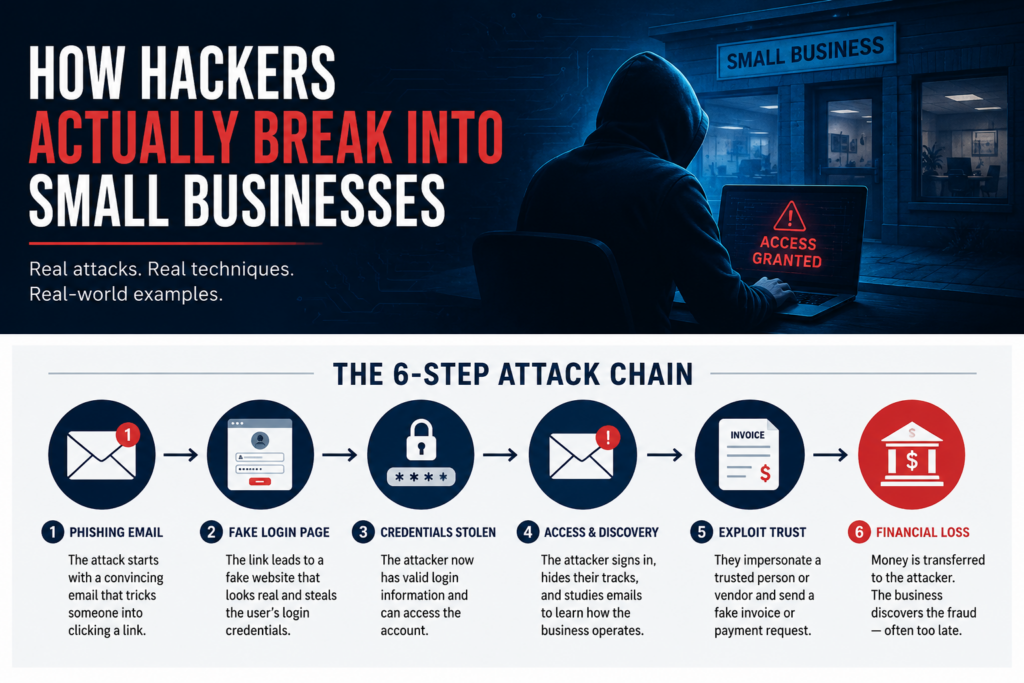
When most people think about hackers, they imagine someone sitting in a dark room furiously typing code to break through firewalls.
The reality is often much less dramatic—and much more dangerous.
Most cyberattacks against small businesses don’t involve sophisticated Hollywood-style hacking. Instead, attackers take advantage of common mistakes, weak security practices, and ordinary human behavior.
Let’s walk through a realistic example of how a modern cyberattack might unfold.
Step 1: The Phishing Email
It starts with an email.
An employee receives a message that appears to come from Microsoft, Google, a shipping company, or even a trusted vendor.
The email looks legitimate. It may contain company logos, professional language, and a link that appears safe.
The employee clicks the link and is directed to a fake login page.
Believing the page is genuine, they enter their username and password.
The attacker now has valid credentials.
Step 2: Accessing the Account
Within minutes, the attacker signs in using the stolen credentials.
In many cases, the login succeeds because the account is protected only by a password.
The attacker now has access to:
- Contacts
- Calendars
- Files
- Internal communications
At this stage, most businesses have no idea anything is wrong.
Step 3: Hiding Their Tracks
Experienced attackers don’t immediately announce their presence.
Instead, they often create mailbox rules that automatically move warning emails into hidden folders.
Security alerts are deleted.
Password reset notifications are hidden.
The victim continues using their account without realizing someone else is reading every message.
Step 4: Learning How the Business Operates
The attacker spends days or weeks observing.
They identify:
- Key employees
- Vendors
- Customers
- Banking relationships
- Payment processes
They learn who approves invoices, who handles payroll, and who has authority to transfer money.
This information allows them to launch highly targeted attacks.
Step 5: Exploiting Trust
Once the attacker understands the business, they begin impersonating trusted individuals.
They may send emails that appear to come from:
- The owner
- The accounting department
- A vendor
- A client
Because the messages originate from a legitimate account, employees are more likely to trust them.
The attacker doesn’t need to defeat your security systems.
They simply convince someone to take an action.
Step 6: Financial Loss
A fake invoice arrives.
A vendor’s banking information is “updated.”
An urgent wire transfer is requested.
Payroll information is changed.
Money is sent.
The attacker disappears.
Only then does the business discover what happened.
Not Every Attack Starts With Email
While phishing remains one of the most common attack methods, it is not the only one.
Attackers also exploit:
Unpatched Software
Software vulnerabilities are discovered every day.
Organizations that delay updates may unknowingly expose themselves to known security flaws.
Weak Passwords
Simple or reused passwords remain one of the easiest ways for attackers to gain access.
Stolen Credentials
Passwords exposed in unrelated breaches are frequently reused across multiple systems.
Misconfigured Systems
Exposed services, unnecessary access permissions, and insecure settings can create opportunities for attackers.
Third-Party Compromises
Businesses increasingly rely on cloud providers, software vendors, and service partners.
A weakness in one organization can affect many others.
Why Small Businesses Are Targeted
Many owners assume cybercriminals only target large corporations.
Unfortunately, small businesses are often attractive targets because:
- Security budgets are smaller.
- IT resources are limited.
- Security controls may be inconsistent.
- Employees often wear multiple hats.
- Attackers know smaller organizations are less likely to detect intrusions quickly.
Cybercriminals don’t necessarily care who you are.
They care whether you are vulnerable.
The Good News
Most attacks are preventable.
Simple steps can dramatically reduce risk:
- Enable multi-factor authentication.
- Keep software updated.
- Train employees to recognize phishing attempts.
- Use strong, unique passwords.
- Review security alerts regularly.
- Limit unnecessary access privileges.
- Monitor systems for unusual activity.
No security strategy can eliminate risk entirely, but reducing easy opportunities often causes attackers to move on to easier targets.
Final Thoughts
Cyberattacks rarely begin with advanced hacking techniques.
More often, they begin with a single click, a stolen password, or an overlooked vulnerability.
Understanding how attacks actually happen is the first step toward preventing them.
The goal isn’t to be perfect.
The goal is to make your business a difficult target.